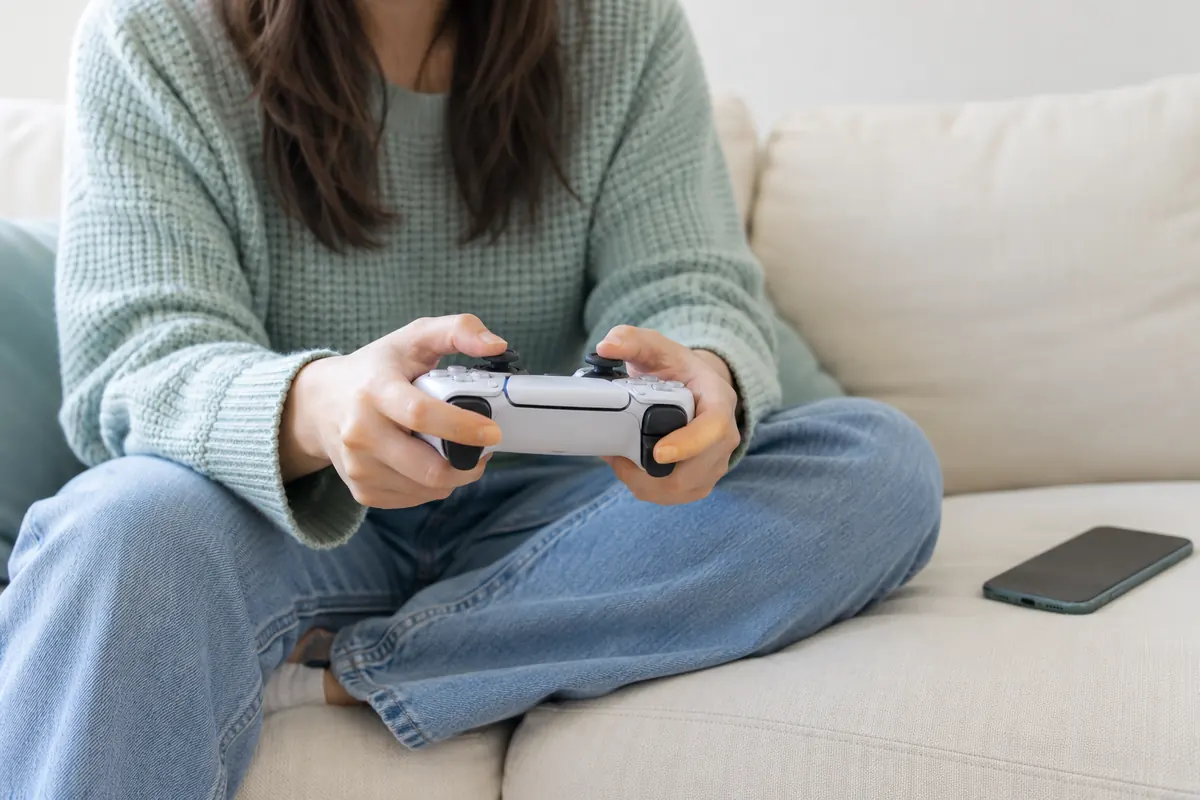
Some evenings I do not want advice, a productivity routine, or another conversation. I want to play something and let the day stop following me around.
Sometimes I come home and I do not want a conversation, advice, another decision or a productive hobby. I want ten minutes where nothing needs an explanation. A game can do that. Sometimes a phone can do it too. I can sit there, look at a screen, and feel my head slowly stop carrying the entire day at once.
If half an hour with a game makes my head quieter and I come back to real life in a better mood, I have a hard time calling that wasted time.
From the outside, that can look stupid. You worked all day and now you are “wasting time.” You are sitting with people and looking at a phone. You are playing a game instead of doing something useful. The visible behavior is easy to judge because the invisible part—the noise that came before it—is not visible.
What looks like doing nothing can still be recovery
I think people underestimate how much effort ordinary life can take when your brain stays switched on. Work, traffic, messages, money, people asking things, small conflicts, being watched, making decisions, remembering what still needs to be done. None of those things has to be dramatic. Stack enough of them together and by the evening you can feel full.
Then someone sees you playing for half an hour and thinks the game is the problem. Maybe sometimes it is. But sometimes the game is simply the only part of the day where the rules are clear, the goal is small and nobody needs anything personal from you.
That distinction matters to me. Rest does not always look impressive. A walk looks healthy. Reading looks intelligent. Meditation looks disciplined. Sitting with a controller or scrolling through something harmless can look lazy even when the function is similar: creating a small gap between you and the day.
Gaming gives the mind a smaller world for a while
A good game can narrow attention. For a while there is a map, a race, a puzzle, a match, a character, a resource to collect. The problems have edges. If you fail, you restart. If you stop, the world waits.
Real life is rarely that polite. Problems overlap. Work follows you home in your head. A message can arrive while you are thinking about money. Someone can ask why you are quiet while you are still processing something that happened six hours ago.
I think this is one reason gaming can feel calming even when the game itself is fast. Calm does not always mean low stimulation. Sometimes calm means your attention is finally pointed at one thing instead of twelve.
There is research behind that general idea. Studies of gaming and post-work recovery have found positive associations between digital game use and recovery, especially when games are immersive.
Another experiment found that twenty minutes with a casual game reduced psychological and physiological stress in university students, although mindfulness produced a larger drop in self-reported stress. So the sensible conclusion is not “games are medicine.” It is that play can be a legitimate recovery activity for some people.
The phone is more complicated than people make it sound
Phones are easier to criticize because they can contain almost everything: work, arguments, news, social media, games, music, videos, friends, shopping and endless scrolling. Saying “the phone relaxes me” can mean very different things depending on what you are actually doing with it.
Sometimes I am not even looking for entertainment. I just want a familiar object in my hand while my brain changes gears. I might watch the same kind of video I have watched a hundred times, read something unimportant, check a game, or put headphones in. It is less about the content than the fact that I can choose the amount of interaction.
That choice matters when you have spent hours responding to other people. A phone lets you be occupied without having to perform. You can stop whenever you want. You do not have to keep a conversation alive. You do not have to explain your face.
But I would not pretend that every version of this works. Recent research on smartphone-based emotion regulation found that people often turned to their phones after negative feelings, but ordinary phone use did not reliably reduce those feelings afterward.
Older work also suggests phones can help with emotion regulation depending on how they are used, especially through social support. The device is not automatically calming or damaging.
The pattern matters.
People often confuse recovery with avoidance
There is a real difference between taking thirty minutes to come down and using a screen to avoid every uncomfortable thing indefinitely. If the game keeps you from sleeping, paying bills, working, moving your body or dealing with something that genuinely needs attention, the recovery explanation starts becoming less convincing.
I use a simple test: do I feel more able to return to my life afterward, or less? If I play for a while and then I can shower, eat, answer what matters and think more clearly, that time probably served a purpose. If I keep extending it because I cannot tolerate stopping, that is a different signal.
The same is true of the phone. Ten minutes of quiet scrolling after a hard day is not automatically the same behavior as losing three hours to content that makes you more irritated, more insecure or more tired.
For an introvert, being unavailable for a while can be the point
I do not think introverts have a special biological need for games or phones. That would be an easy stereotype. What I do recognize is the need to stop being socially available.
After enough interaction, I sometimes do not want another good conversation. It is not because I dislike the person. I just do not want to generate another response. I want something that receives my attention without demanding my personality back.
That is close to what I wrote about in You Didn’t Hate the Evening. You Just Need Everyone to Stop Talking for a While.: enjoying people and needing distance from them can both be true. A screen can become one of the ways that distance happens. Not the only way, and not always the best way. Just one way.
This is also why “put the phone down and talk to us” can occasionally miss the point. The person may not be choosing the phone over you. They may be choosing ten minutes of low-demand space before they can be properly present again.
The outside observer sees the object, not the reason
People are good at judging visible habits. Someone looks at a phone: addicted. Someone plays games: immature. Someone lies in bed: lazy. Someone goes for a two-hour walk: healthy. The labels arrive before the context.
But two people can perform the exact same behavior for completely different reasons. One person is playing because they are avoiding a deadline. Another finished everything important and is decompressing. One person is scrolling because they feel trapped in a compulsive loop. Another is reading jokes for fifteen minutes after a twelve-hour shift.
You cannot reliably tell the difference from across the room.
That is a useful thought beyond screens too. We often judge the shape of somebody’s coping without knowing the weight it is carrying. Why You Sometimes Want to Disappear Without Wanting to Leave Anyone comes from a similar place: sometimes wanting to become unreachable for a while is not rejection. It is relief from being reachable.
A better question is what happens after
Instead of asking whether gaming is good or bad, I think the more useful question is what it does to the rest of your life.
Does it leave you calmer? Does it give you a clean break from work? Do you laugh with friends? Do you enjoy the challenge? Can you stop? Do you still sleep? Do you still handle your responsibilities? Are you choosing it, or does it feel like you have no other way to settle your head?
Those questions are less dramatic than “screens are ruining us,” but they are much harder to answer honestly.
The answer can change too. Something that helped during one period can become a bad habit later. A game can be recovery in one hour and avoidance in the fourth. A phone can connect you to someone you need and then keep you awake with things you did not need to see.
Not every quiet moment has to look productive
I think this is the part I care about most. People have become strangely interested in making rest look respectable. If you relax, it should improve you. Read a serious book. Stretch. Journal. Learn a language. Listen to a podcast that teaches you something.
Those things are fine. I do some of them. But sometimes I do not want my recovery to become another project.
Sometimes I want to play something pointless, watch something familiar, sit with my phone and let the day become smaller. I do not need every free minute to produce a stronger, richer, wiser version of me.
If the screen is taking your life away from you, that deserves attention. If it is giving you a little piece of your attention back after the world has been borrowing it all day, that deserves a more careful judgment.
Sometimes somebody looking at a phone is ignoring the room.
And sometimes they are just trying to come back to it.